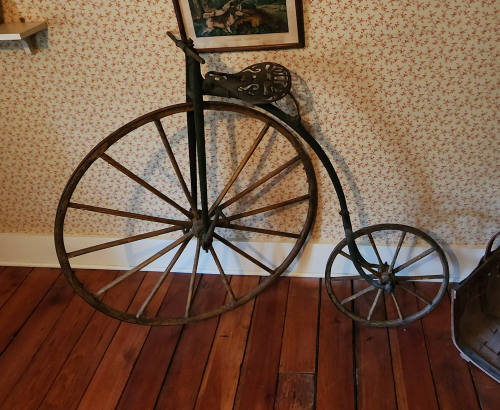


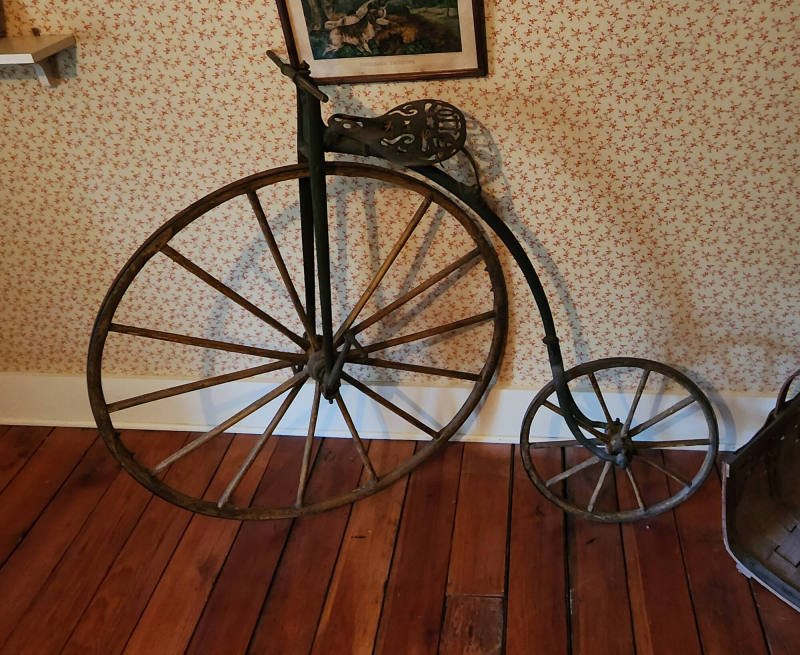
Otto Highwheel Bicycle
Object NameOtto Highwheel Bicycle
Manufacturer
Western Toy Company
(Chicago, IL, founded 1876)
Date1876-1880
MediumWood, metal
Dimensions43 1/2 × 48 in. front wheel to back wheel (110.5 × 121.9 cm)
ClassificationsDolls, Doll Accessories, Toys and Games
Credit LineGift of Mr. & Mrs. Farwell Brown. In the Farm House Museum Collection, Farm House Museum, University Museums, Iowa State University, Ames, Iowa.
Object number78.19.1
Status
On viewCollections
CultureAmerican
Label TextFrom the University Museums Collections Handbook, vol. 2, 2025:
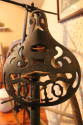
The Otto Highwheel Boys Bicycle, produced by the Western Toy Company, is a charming example of early bicycle design. This vintage bicycle features a distinctive design with a large wooden front wheel and a much smaller wooden rear wheel, complemented by an iron saddle that bears the stamped name “OTTO.” The handlebars, which span an impressive 18 in. from end to end, offer both style and functionality, while the overall height of the bicycle measures around 43 ins. Designed with boys and small men in mind, this model was manufactured between 1879 and 1891, making it a popular option during a time when cycling was emerging as a fashionable pastime. However, as the years progressed, newer models with metal wheels quickly replaced the highwheel design, marking the end of its era.
This particular highwheel bicycle holds a special place in local history as it was the very first of its kind utilized in Ames, Iowa. Originally owned by Gates M. Brown in the 1890s, the bicycle was later passed down to his younger brother, Harry F. Brown. The lineage continued as Harry entrusted the treasured bike to his son, Farwell T. Brown, who rode it in the Iowa State VEISHEA parade of 1934 (picture in the Ames History Museum archives). This passing of the bicycle through generations not only highlights its durability and enduring appeal but also illustrates the sentimental value attached to such historic objects. The Otto Highwheel remains a fascinating object in the collection, representing both innovative design and the cherished memories of those who rode it.
VEISHEA was an annual Spring celebration of Iowa State academics. The acronym stood for the 5 original colleges of the university: Veterinary Medicine, Engineering, Industrial Science, Home Economics, and Agriculture. The first VEISHEA was held May 11-13, 1922, as a combination of the different colleges’ Spring traditions. VEISHEA traditions included a parade, college open houses, stars over VEISHEA (a studentled performance), and cherry pies, among others. Although well loved by students, the celebration faced numerous problems over the years. World War II led to cutbacks on the event in the 40s. In 1970, VEISHEA was scheduled to occur just one week after the Kent State Massacre, leaving the event organizers to quickly pivot scheduled activities to be respectful of those killed or injured during the event. By the 1980’s, VEISHEA had become less of a celebration of school spirit and more of a week-long party, coming to be known as the “largest party in the Midwest”. Riots occurred in both 1988 and 1982. In 1997, a visitor to the event was fatally stabbed in the yard of the Adelante fraternity. VEISHEA was canceled in 2005 after another riot occurred in 2004 (Iowa State University 2010). Amid controversy, the event limped along until 2014, when a riot on Welch Avenue led to the destruction of property and the injury of one man. It was after this event that then President Steven Leath made the decision to end VEISHEA permanently.
Iowa State University Library Special Collections Department. 2010. VEISHEA: Iowa State’s Rite of Spring. Accessed May 23, 2025. https://historicexhibits.lib.iastate.edu/VEISHEA/home.html. Kealey, Kate. 2024. “Whatever happened to Iowa State’s Veishea? This year marks a decade without the celebration” Des Moines Register, April 9.
Locations
- (not entered) Iowa State University, Farm House Museum, 3rd Floor, W Bedroom