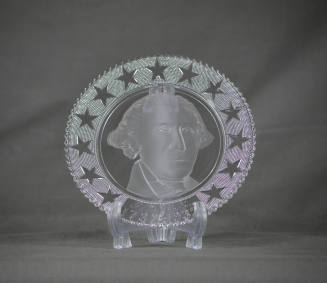
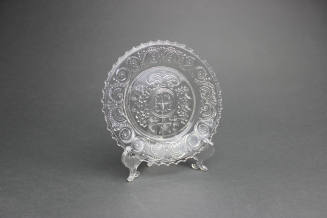
George Washington pattern
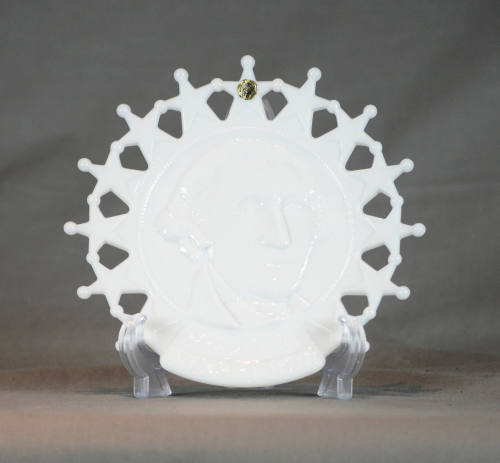
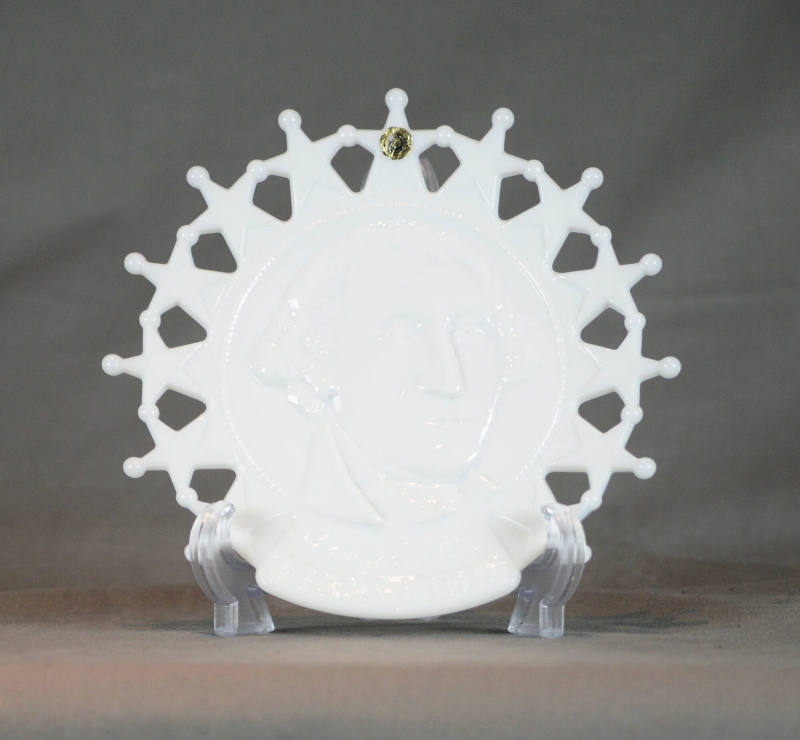
Object NameHistorical Plate
Manufacturer
Westmoreland Glass Co.
(American (Grapeville, PA), 1889 - 1984)
Date1932
MediumNon-flint white milk pressed glass
Dimensions3/4 × 8 × 8 in. (1.9 × 20.3 × 20.3 cm)
ClassificationsDecorative Arts, Glass
Credit LineGift of Linda Randell, member and past president of Robert Lucas #314. In the Iowa Quester Glass Collection, Brunnier Art Museum, University Museums, Iowa State University, Ames, Iowa.
Object numberUM2011.258
Status
On viewCollections
CultureAmerican
Label TextGeorge Washington played a central role in founding the United States and earned the title “Father of His Country.” Born in 1732 in Virginia, he first gained prominence as a military leader during the French and Indian War. He later commanded the Continental Army during the American Revolutionary War, where his leadership and perseverance helped secure independence from British rule despite limited resources and numerous challenges. After the war, Washington served two terms as the first president of the United States, from 1789 to 1797.
Artists and craftsmen made George Washington a powerful and popular theme in American decorative arts during the late eighteenth and early nineteenth centuries. People featured his likeness on ceramics, silverware, furniture, textiles, prints, and household items such as clocks and glassware, portraying him in idealized poses modeled after classical Roman heroes or dignified statesmen. These objects reflected a desire to associate the new republic with virtue, leadership, and stability. By displaying such items in their homes, Americans expressed patriotism and allegiance to the ideals of the young nation.
Artisans and manufacturers in the United States and abroad reproduced Washington’s portrait to meet public demand, turning his likeness into one of the earliest mass-produced national icons. This particular plate was issued for the Washington Bicentenary in 1932. Over time, these decorative representations blurred the line between fine art and everyday objects, embedding political symbolism into daily life. Through these items, people transformed Washington’s image into not just a reminder of an individual leader, but a lasting emblem of American values and collective memory.
Locations
- (not entered) Iowa State University, Farm House Museum, Library
Object Name: Dual Portrait
Rose Frantzen
2015
Object number: U2015.2
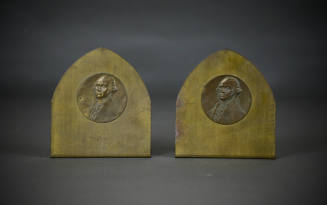
Object Name: Cup Plate
Boston & Sandwich Glass Co.
1832-1840s
Object number: UM2016.878
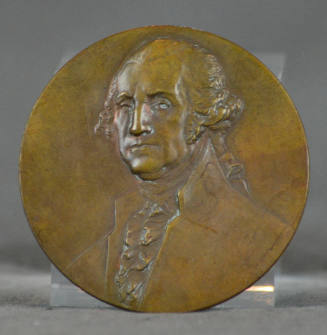
Object Name: Medallion
Christian Petersen
1912-1914; 1924-1934
Object number: UM2019.2
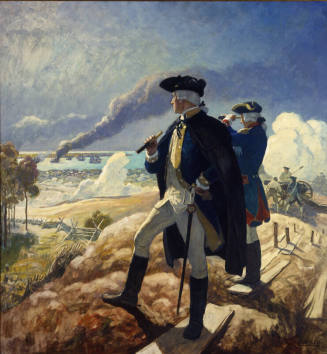
Object Name: Painting
Newell Convers Wyeth
1938/1939
Object number: UM83.17
Object Name: Drawing
Christian Petersen
c. 1949
Object number: um92.112