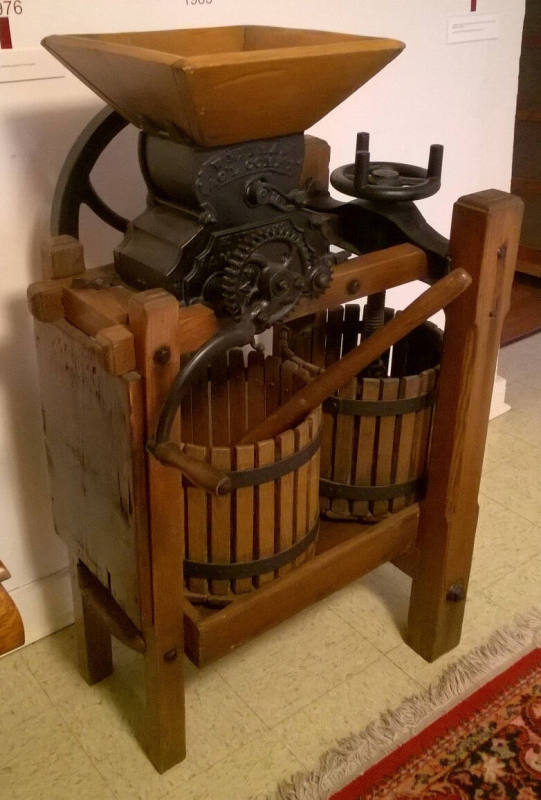
Cider Press
Object NameCider Press
Manufacturer
Whitman Agricultural Co.
(American (St. Louis, MO), founded 1870)
Date1874
MediumOak and cast metal
ClassificationsTools, Implements and Scientific Equipment
Credit LineGift of Drs. David G. Topel and Jay-lin Jane Topel. In the Topel and Cheng Art Collection, University Museums, Iowa State University, Ames, IA.
Object numberUM2016.281
Status
On viewCollections
CultureAmerican
Label TextFrom the University Museums Collections Handbook, vol. 2, 2025:
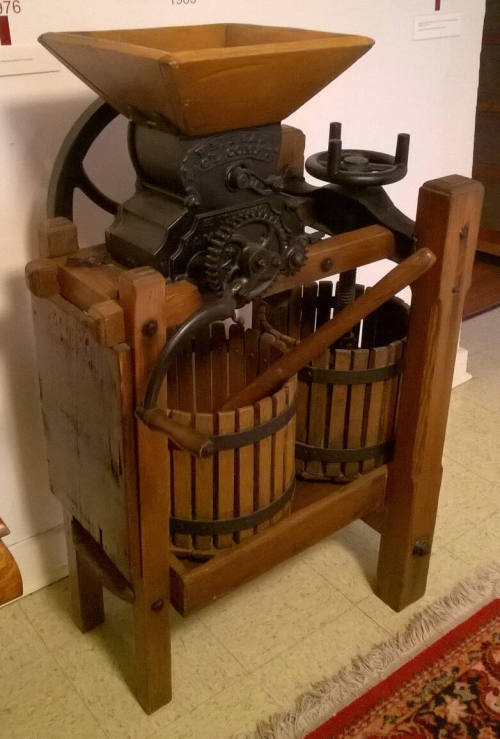
The cider press holds a special place in American history from the arrival of Europeans into the 20th century and beyond. This press was made by the Whitman Agricultural Company, St. Louis, Missouri, and patented in July 1874. The press is made of oak, one of the heaviest woods, and tough cast iron moving parts. Apples go into the funnel; the crank turns a wheel which mashes the apples. This process continues until the mash fills the cloth-lined barrel. A weight is then placed on the mash and the wheel is turned to press the juice out. The apple juice seeps out through the cloth and loaded into barrels to ferment into hard cider.
Hard cider was the primary drink for Americans since the 16th century. Settlers found that grains and barley needed to make beer could not be grown in the harsh climate and soil of New England and the distillation process for liquor too labor intensive on the frontier. Apples proved to be the solution, and it was common to see an orchard on every farm and cider at every meal. The sharp decline for cider came in the 19th and 20th century for two reasons: European immigrants preferred beer; and the rise of the middle class during the Market Economy significantly curbed the consumption of hard cider – the beginning of moral reform. Hard cider did not recover after the repeal of Prohibition in 1933. Orchards that survived the sudden drop in demand for hard cider began cultivating sweeter apples for cooking and consuming raw. This press was used at Iowa State College in its formative years of the 1870s, likely to demonstrate cider production in tandem with the orchards on campus.
Locations
- (not entered) Iowa State University, Farm House Museum