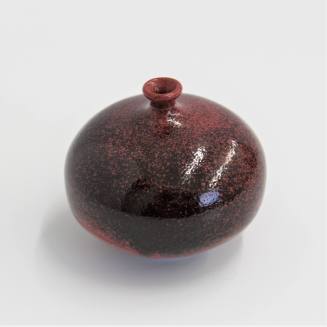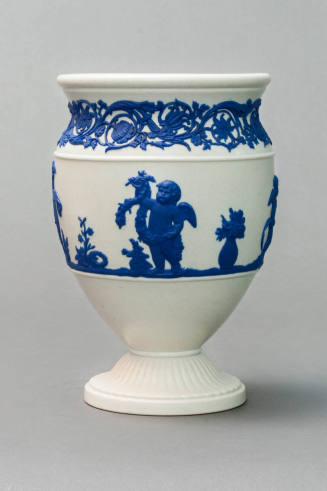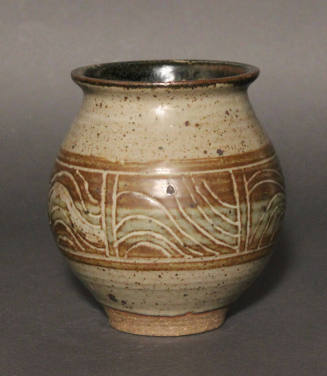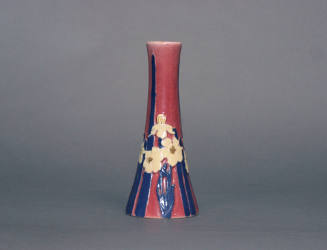
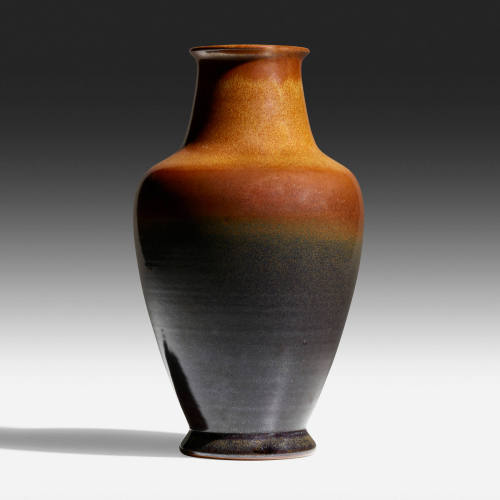
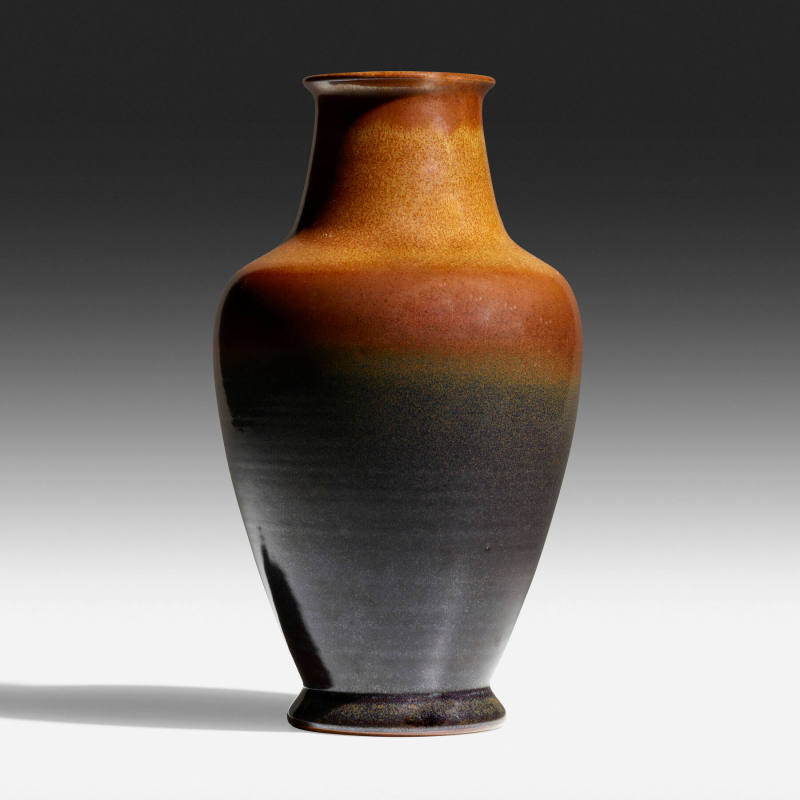
Vase
Object NameVase
Artist / Maker
Charles Fergus Binns
(English-American, 1857 - 1934)
Date1929
MediumMicrocrystalline glazed stoneware.
DimensionsOther: 9 3/4 × 5 in. (24.8 × 12.7 cm)
ClassificationsDecorative Arts, Ceramics
Credit LinePurchased by University Museums with funds from the Joyce Tomlinson Brewer Fund for Art Acquisition. In the permanent collection, Brunnier Art Museums, University Museums, Iowa State University, Ames, Iowa.
Object numberUM2021.2
Status
Not on viewCultureEnglish-American
Label TextBorn and educated in England, Charles Fergus Binns was already an accomplished ceramist and instructor when he moved to America at the age of 40 in 1897. Well-known within the American ceramics industry thanks to his writings for The Ceramic Monthly, he gave lectures in New York and Cincinnati that same year, published his book The Story of the Potter in 1898, and helped to establish the American Ceramic Society in 1899. But Binns’ career and legacy would be shaped primarily by his appointment as director of the New York State School of Clay-Working and Ceramics (now the New York State College of Ceramics at Alfred University), which was founded in 1900 in upstate New York. He remained in the position until 1931, teaching a multitude of students, many of whom would go on to become some of the country’s leading ceramists, including Adelaide Robineau, Frederick Walrath, Mary Chase Perry, Arthur Baggs, Elizabeth Overbeck, and Maija Grotell.
Binns’ own work was heavily inspired by Asian aesthetics and is characterized by simple, balanced forms with restrained, mostly matte glazes. He preferred throwing his vases in sections to allow him absolute and exacting control over the final shape, and because, he claimed, it was standard practice for Chinese potters. His 1910 book The Potter’s Craft was the first American instructional manual for pottery making, and he wrote countless articles for Adelaide Robineau’s Keramic Studio, Gustav Stickley’s The Craftsman, and other trade publications.
Binns left an indelible mark on the history of the medium through his writings, teachings, and success of his students. It is only fitting that he is referred to as “the father of American studio ceramics”.
___________________________________
From the University Museums Collections Handbook, vol. 2, 2025:
Charles Fergus Binns is known as “the father of studio ceramics” due to his prolific hands-on teaching, mentorship, and writing that trained a generation of ceramic artists in the United States. Born in England into a family already working in ceramics, Binns began as an apprentice at the age of fourteen in the Royal Worcester Porcelain Works. He became known as a scholar of ceramics around the world and lectured widely. In the late 1890s he moved to the United States and, after the establishment of the New York School of Clay-Working and Ceramics (today known as the New York State College of Ceramics at Alfred University), he was appointed the first Director of the school in 1900. He remained there until 1931 and his influence on the production of ceramics was immense as he trained many of the best-known early 20th century ceramicists, including Paul Cox who began Iowa State College Pottery in Ames. Binns also wrote The Potter’s Craft in 1910, which was reprinted three times and was a highly influential guide that aided potters in understanding the science and artistry of ceramics. His own objects were simple, well-constructed, Asian-inspired forms, with matte or innovative glazing techniques.
MarkingsMuseum accession number in red to underside ‘1930.16’.
PeriodArts and Crafts
SignedIncised signature and date to underside ‘C.F.B. 1929’.
Locations
- (not entered) Iowa State University, Brunnier Main Storage