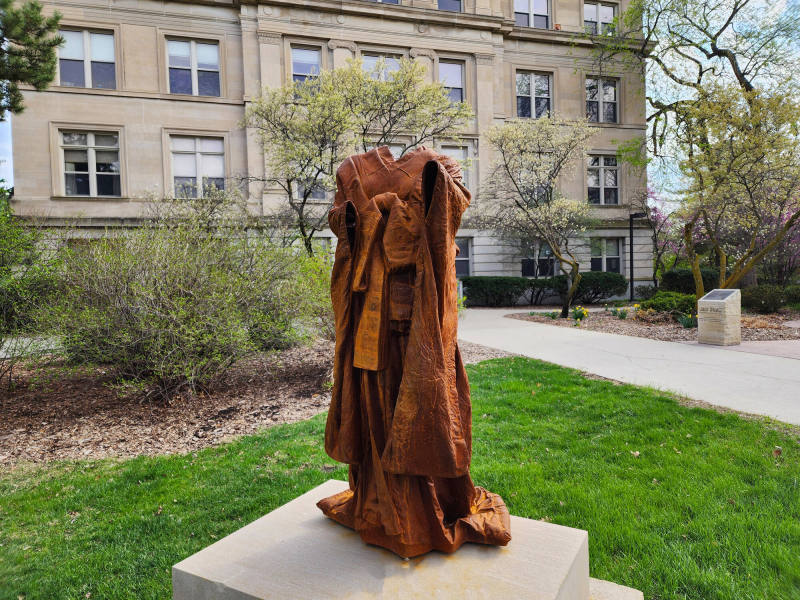
Kabuki
Object NameSculpture
Artist / Maker
Karen LaMonte
((American, b. 1967))
Date2012
MediumIron
Dimensions60 × 32 × 33 in. (152.4 × 81.3 × 83.8 cm)
ClassificationsSculpture
Credit LinePurchased by University Museums with funds from the Joyce Tomlinson Brewer Fund for Art Acquisition. In the Art on Campus Collection, University Museums, Iowa State University, Ames, Iowa.
Object numberU2024.206
Status
On viewCollections
CultureAmerican
Label TextFrom the University Museums Collections Handbook, vol. 2, 2025:
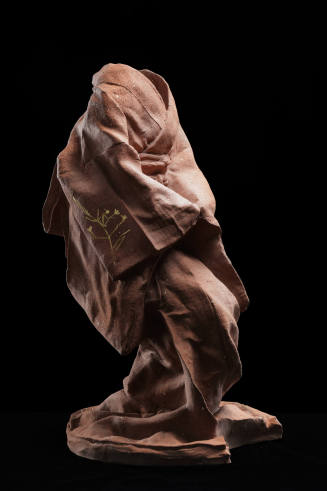
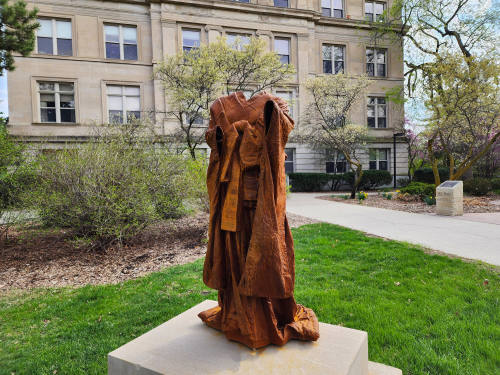
Much of Karen LaMonte’s early inspiration for her cast glass figurative sculpture was founded in Western standards of beauty and dress, but in 2007, she began a seven-month fellowship in Kyoto through the Japan−U.S. Friendship Commission to fully immerse herself in the complex cultural information communicated through creating, decorating, and wearing the kimono. During this time, LaMonte discovered that, in contrast to typical Western ideals of femininity, the Japanese kimono aesthetic seeks to remove any reference to the female form. Returning with 250 kimonos to her studio in Prague, Czech Republic, she felt a need to expand beyond cast glass to represent these Japanese values and began working with clay for humility, glass for spirituality, bronze for human intention, and rust for transience. After six years of work, LaMonte presented her Floating World series, including Kabuki, which exquisitely communicates the Japanese aesthetic and sense of beauty in solid form.
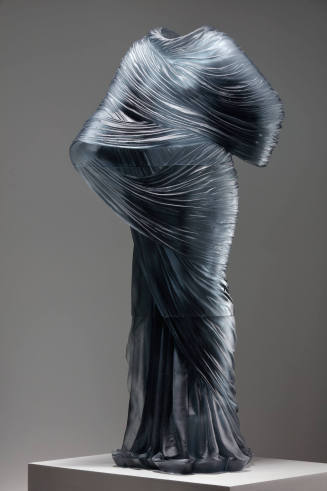
Karen LaMonte explores the female form with reference to clothing used to cover and attire a body while also communicating personal and cultural identities. She most often uses massive cast glass as her medium, employing a painstaking process to create a final product where the human form is removed from the sculpture, yet the impression of the body remains within the clothing or drapery, as can be seen in another sculpture in the permanent collection by LaMonte: Nocturne 5 in Morrill Hall. Both Kabuki and Nocturne 5 embody physicality without an actual human form, giving an ethereal appearance alluding to the shape and movement of a female body.
Locations
- (not entered) Iowa State University, Anderson Sculpture Garden