
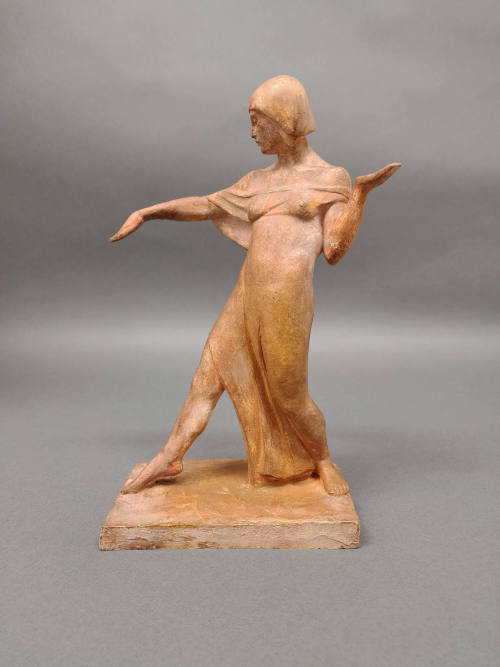
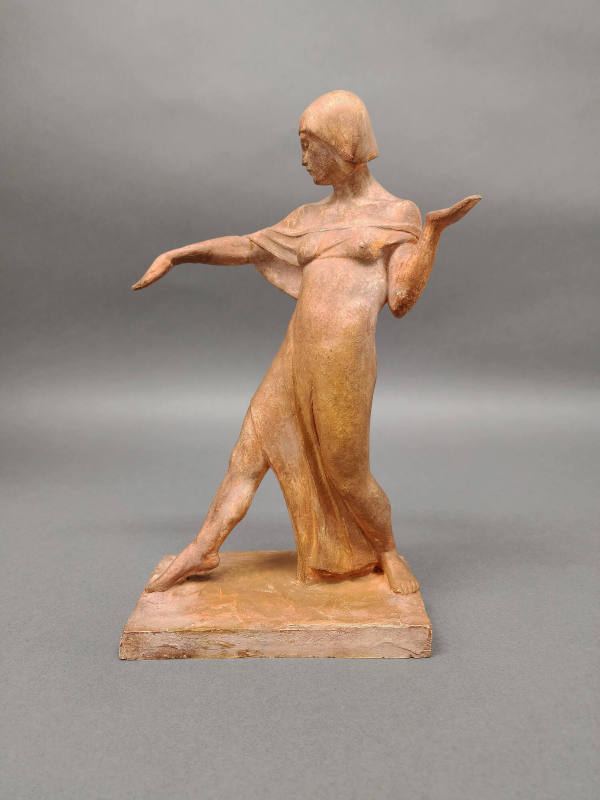
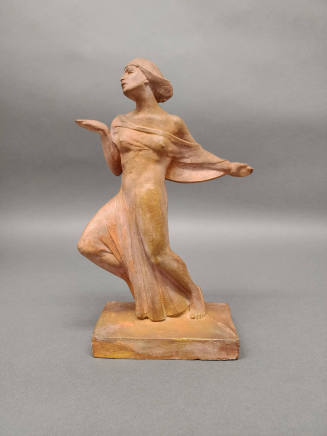
Dancing Woman
Object NameMaquette
Artist / Maker
Christian Petersen
(Danish - American, 1885 - 1961)
Date1936-1939
OriginUSA
MediumPainted plaster
Dimensions13 1/8 x 9 x 3 1/2 in. (33.3 x 22.9 x 8.9 cm)
ClassificationsArt on Campus Preparatory Studies and Maquettes
Credit LinePurchased in memory of Ruth Smith. Conservation funded by Stockman Foundation. In the Christian Petersen Art Collection, Christian Petersen Art Museum, University Museums, Iowa State University, Ames, Iowa.
Object numberUM98.3
Status
Not on viewCollections
CultureAmerican
Label TextFrom the University Museums Collections Handbook, vol. 2, 2025:
Petersen’s subtle embrace of modernism is evident in his war memorials from the 1920s. His Spanish-American War Memorial (1923) features a strongly modeled female figure draped in classical garments. While grounded in the Beaux-Arts tradition, the sculpture demonstrates a style of modeling that would become a hallmark of Petersen’s later public works of art in the 1930s. This style is also present in the artist’s two Dancing Woman figurines, both just over 13 in. tall, which were sculpted and painted to resemble terra cotta. These figures represent the original designs for the Fountain of the Four Seasons (1940−1941) at Iowa State’s Memorial Union, though they were ultimately rejected in favor of a more conservative subject.
The figures movement is accentuated by off-shoulder gowns, with one arm extended outward and the other folded at the elbow, bent at the wrist. One leg is extended and exposed, while the other stands poised, ready to spring forward. The dynamic poses and modernist qualities of the figures recall sculptures of mythological narratives, a common subject in the work of American sculptor and Petersen contemporary, Paul Manship (1885−1966). Manship’s simplified lines and details moved away from classical realism, a shift also reflected in Petersen’s figural depiction of Dancing Woman. Rather than focusing on the intricate articulation of muscles and joints, Petersen emphasizes the fluidity of movement. The simplicity of these finished sculptures, with geometric compositions of cylinders and planes, suggests a response to the modernist trends that were emerging in post World War I art.
Object Titles[com.gallerysystems.emuseum.core.entities.ObjectTitle@997b]
Locations
- (not entered) Iowa State University, Morrill Hall

Object Name: Portrait
E. Suderitz
1882
Object number: UM99.27
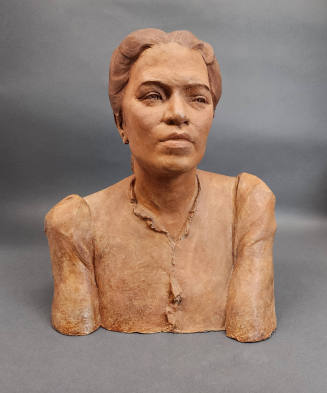
Object Name: Portrait Bust
Christian Petersen
1946
Object number: U89.34
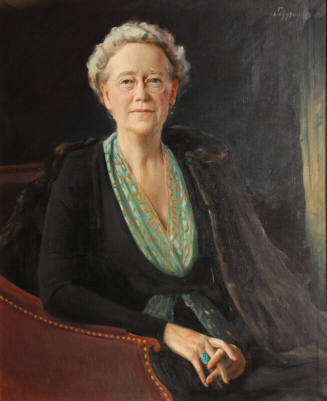
Object Name: Portrait
Frank I. Johnson
1943
Object number: U82.126
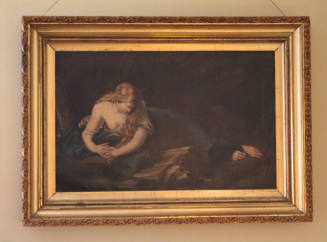
Object Name: Painting, copy / reproduction
Pompeo Girolamo Batoni
c. 1890s
Object number: 92.4.3