Washtub Blues
Object NameWoodcut print
Artist / Maker
Allison Saar
(African-American, b. 1956)
Date2000
MediumWoodcut on unbleached Thai mulberry paper
Dimensions30 x 22 in. (76.2 x 55.9 cm)
ClassificationsPrints and Printing Plates
Credit LineGift of Diane Greenlee for the Carrie Chapman Catt Center for Women in Politics. In the Art on Campus Collection, University Museums, Iowa State University, Ames, Iowa.
Object numberU2003.34
Status
On viewCollections
CultureAmerican
Label TextFrom the University Museums Collections Handbook, vol. 2, 2025:
Alison Saar, a well-known mixed media artist and sculptor from California, often focuses on the African diaspora in her work. She uses carved wood in sculpture and woodprint blocks for prints, with imagery influenced by folk art and spirituality. Saar’s work focuses on the human figure to convey identity and examine historical events.
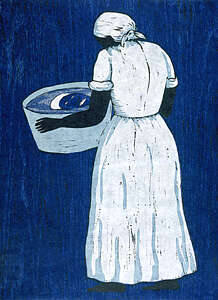
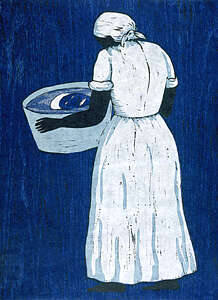
One theme frequently found in Saar’s body of work is reflection, which is evident in Washtub Blues. This print was created for the exhibition, Expanded Visions, Women Artists Print the American West, in collaboration with printmaker Bud Shark. The print depicts a Black woman gazing into a washtub, her face reflecting back. The print addresses the erasure of women’s labor and the misperceptions of Black Americans, aligning it with Saar’s larger body of work.
------------------------------------------------------------------------------------------------------------------A lot of my work has explored the role of women--African American women in particular--and their role in the economic survival of families. On a personal level, I have a deep sense of belonging to that group by the mundane tasks I do. When I was thinking about this print for the Women of the West Museum, it occurred to me that most of the famous black women in the West began as laundresses or cooks. They were self-made survivors who became property owners, who achieved success by starting from the bottom. Often, they used their money to help others. Ultimately they are heroic. They made their menial, unrewarding work meaningful, maybe not for themselves but for others. Housekeepers and nannies have a huge impact on people's lives and they are rarely recognized. Often they're invisible; you don't even notice them. That's why in this print of a laundress you see her from behind, with her face reflected in the tub of water.
--Alison Saar
Locations
- (not entered) Iowa State University, Memorial Union, Multicultural Center


Object Name: Print or Drawing
Jay Norwood Darling
Object number: um95.72
Object Name: Preliminary Sketches
Jay Norwood Darling
Object number: um95.75
Object Name: Preliminary Sketches or Drawings
Jay Norwood Darling
Object number: um95.73

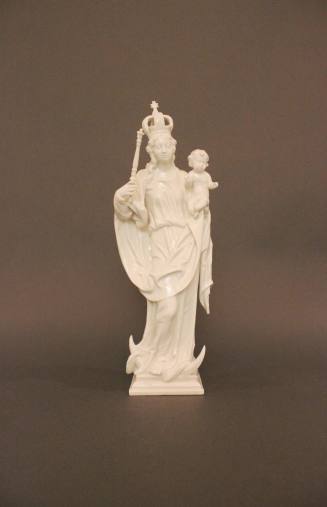
Object Name: Figurine and Scepter
Porzellan Manufakture Nymphenberg
Mid 20th century
Object number: 2.6.71ab