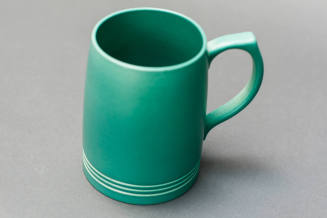
Keith Murray
Keith Day Pearce Murray (5 July 1892 – 16 May 1981) was a New-Zealand-born British architect and industrial designer, known for ceramic, silver and glass designs for Wedgwood, Mappin & Webb and Stevens & Williams in the 1930s and 1940s. He is considered to be one of the most influential designers of the Art Deco / Modern age.
By 1910–11 Murray was working as a draughtsman for the architect Arthur Pollard Wilson / Wilson & Moodie in Victoria Arcade, Queen Street, Auckland. In 1910 he took on the office of secretary for the newly formed Aero Club of New Zealand, with Leo Walsh as club president. That year the club entertained Frederick Walker Baldwin and Alexander Graham Bell during their tour of Australia and New Zealand, they having expressed a great interest, on hearing of the club, to meet with club members and inspect their flying machines. Murray promoted the progress of the Walsh Aeroplane Syndicate's Howard Wright biplane, and club activities. In addition to designing the club's winged emblem badge, he also designed a glider for the club's in-house glider design competition, in which he gained second place out of the six entrants. He worked for Wilson & Moodie until 1914, when, it appears, he moved to England to study architecture.
Following the war, Murray graduated from the Architectural Association School of Architecture in London in 1921 and that year was elected an associate of the Royal Institute of British Architects. However a lack of work forced him to make a living as an illustrator for magazines. In 1928 he held his own show at the Lefevre Gallery in London but this was not to prove his passion.
His visits to exhibitions such as the 1925 Paris Exposition and the 1931 Exhibition of Swedish Industrial Art in London inspired Murray to seek out opportunities to design vases and tablewares for factory production, and as the Great Depression of the early 1930s further reduced the demand for architecture he became a full-time designer.
Murray first approached Arthur Marriott Powell about the possibility of working in Whitefriars Glass in London. Though his ideas proved unsuitable for their style of glass, he worked as a freelance designer at Stevens & Williams of Brierley Hill in the West Midlands in 1932. The trial pieces were shown in London that year and the 'Keith Murray range' was produced. Between 1932 and 1939 he produced over 1200 designs though many were only issued in quantities of six or twelve.
In 1932, he also began working 2–3 months a year for Josiah Wedgwood and Sons. Josiah Wedgwood invited him to visit the Wedgwood Factory. He was then employed to produce designs for dinner and teaware. It is here that Murray's famous ribbing designs began to form. His first range was entitled 'Annular'.
In 1934 the royal silversmiths Mappin & Webb approached him and asked if he could produce bowls and vases in silver working to the same designs as his Wedgwood pieces.
Most of his work was with vases, bowls and similar cylindrical ware, executed in a clean and restrained style with decoration often limited to deeply incised lines or smooth steps in the shape. The whole piece is usually one colour without applied decoration. From the beginning Murray's stature as a designer was recognised as every piece bore his signature above the Wedgwood mark.
SOURCE - https://en.wikipedia.org/wiki/Keith_Murray_(ceramic_artist) (Nov 2025)