Charles Atherton Cummings
Cumming, March 31, 1858–February 16, 1932, –painter, teacher, and arts administrator—was born in Rochester, Illinois, to George Pax-ton Cumming and Eliza Ellen (Atherton) Cumming. His father, a farmer and schoolteacher, died in the Civil War.
Charles begandrawing as a child, learning to love and appreciate nature and the wonders and beauty of life. He was taught how to do fancy writing and won a first prize in drawing at a county fair exhibit. His high school years were spent at Weatherfield High School in the Spoon River area of Knox County, Illinois. After high school, he briefly attended Reading College Academy, Abingdon, Illinois, then enrolled at Cornell College, Mount Vernon, Iowa. Cornell did not offer art classes, but his talent became so apparent that he was encouraged to transfer to the Chicago Academy of Design (now the Art Institute of Chicago) so that he could get the quality of training he needed. While there (1878-1879), he studied with Lawrence C. Earle.
During his prime, Cumming contributed to or led in the work of a number of other organizations and programs in central Iowa. He was named to the Capitol Improvements Commission (renamed the Iowa Capitol Commission), which had much to do with the acquisition, commissioning, and placing of murals and other art works in state government buildings. In 1912 he was commissioned to paint a large mural for the Polk County courthouse. In 1914 he became superintendent of the Department of Art at the Iowa State Fair and joined the board of the Des Moines Association of Fine Arts. During these same years, with four of his students, he formed the Iowa Art Guild, which held programs and exhibits for its members into the latter half of the 20th century.
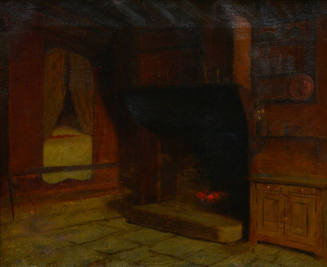
Cumming became widely recognized for his work. He was much sought after as a portrait painter, but he also did still life, genre subjects, and landscapes in oil, his favorite medium. A special relationship evolved between the artist and the State Historical Society of Iowa, which often called on him to do portraits for its collection. The society still holds at least 24 of his works, more than by any other artist. Stylistically, his images ranged from academic realism to impressionist in flavor and color. He stuck to his academic ideas, bucking newer trends, although he did employ some of them when they could be worked into a representational or realist approach. As "modernist" tendencies began to dominate the art scene, Cumming's influence lessened, and his art received diminished attention. He died in Des Moines in 1932 after spending a couple of years in California.
Charles Atherton Cumming occupies a niche in Iowa history as one of the first Iowans to gain considerable stature and recognition as an artist, as a participant and leader in many arts programs, and as an arts administrator. He is one of the roots of Iowa's rich visual arts tradition.
SOURCE - https://uipress.lib.uiowa.edu/bdi/DetailsPage.aspx?id=82 (Sept, 2025)