
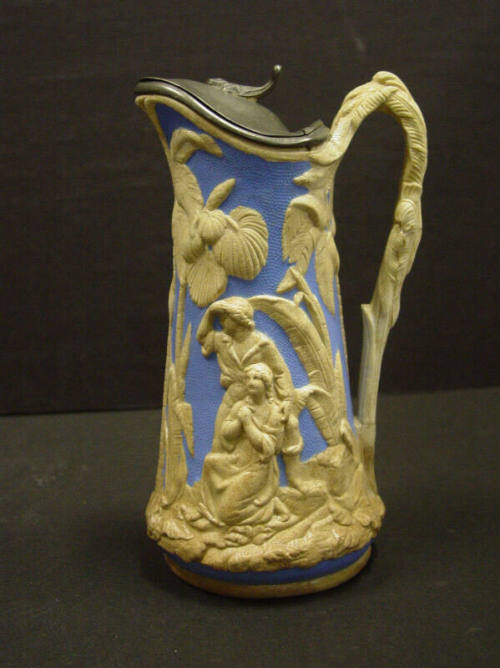
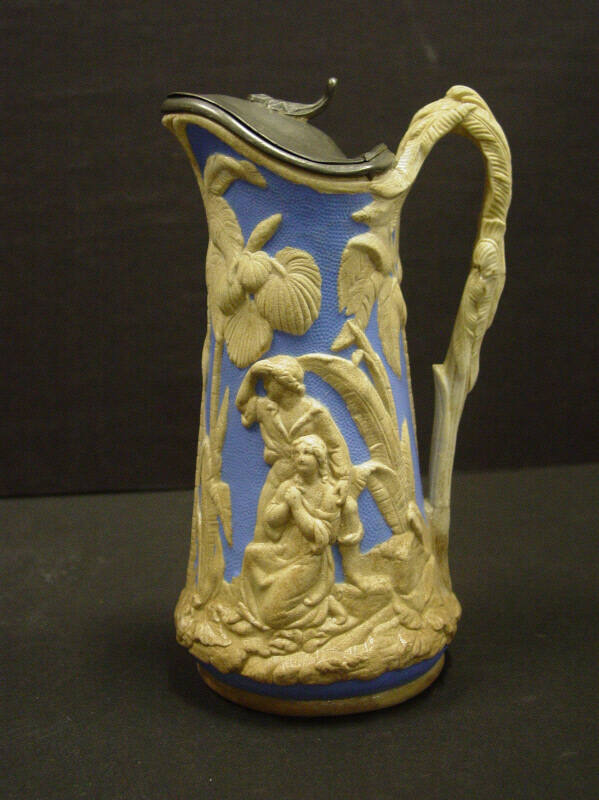
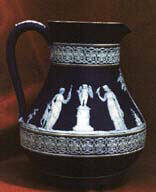
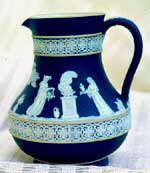
Paul and Virginia
Object NameParian Pitcher
Manufacturer
United States Pottery Company
(American (Bennington, VT), 1847 - 1858)
Date1852-1858
OriginNorth America
MediumCeramic
Dimensions7 1/4 × 2 3/4 × 3 1/16 in. diameter (18.4 × 7 × 7.8 cm)
ClassificationsDecorative Arts, Ceramics
Credit LineGift of Ann and Henry Brunnier. In the Ann and Henry Brunnier Collection, Brunnier Art Museum, University Museums, Iowa State University, Ames, Iowa.
Object number2.15.1
Status
On viewCollections
CultureAmerican
Label TextParian ware is a fine porcelain that imitates the look of carved marble. In the Antebellum United States, households embraced it for decorative objects because it offered an elegant appearance at a much lower cost than real marble. Although Parian ware grew popular, only a small number of North American companies produced it, which makes surviving examples difficult to find today. One of these manufacturers, the United States Pottery Company, gained recognition as the first American firm to make Parian ware. During its short operation, the company created many Parian pieces, including this pitcher titled Paul and Virginia, named after a popular late-18th-century French romance novel.
Victorians especially favored Parian ware because it made the marble look affordable and accessible to the middle and lower classes. English manufacturers likely introduced the material around 1842, and it soon spread westward to America. In 1851, multiple companies displayed Parian ware at the Great Exhibition in London, where visitors admired it so much that judges could not agree on a single inventor. Makers most often used Parian ware for busts and statues, but they also produced smaller items such as vases and tableware like this pitcher. Although this piece never appeared at a world’s fair, it represents the type of Parian ware that drew strong attention at early exhibitions.The United States Pottery Company further established its reputation in 1853 when it produced a ten-foot-tall ceramic monument for display at the New York Crystal Palace Exhibition.
________________________________________________________________________
The United States Pottery Company, as it became known, was an innovative enterprise that focused on producing decorative objects for the home. Employing as many as 200 workers, the pottery became known for its technical achievements, such as the patent of a flint enamel glazing process. In addition, the United States Pottery Company was the first American company to produce Parian ware, a fine grade porcelain. The company gained recognition in 1853 when it produced a ten-foot high ceramic monument that was feature at the New York Crystal Palace Exhibition of 1853. Over-expansion, rising production costs, and an economic recession forced the closing of the United States Pottery Company in 1853.
This pitcher’s pattern name, “Paul and Virginia,” refers to a popular French novel of innocent young love first published in the late 1700s. Much of the story is set on the tropical island of Mauritius, which was then under French control and called Isle de France.
Locations
- (not entered) Iowa State University, Farm House Museum


Object Name: Mural (three panels)
Grant D. Wood
1936-1937
Object number: U88.68abc

Object Name: Painting
Newell Convers Wyeth
1939
Object number: UM90.53
Object Name: Figure Group: dancers
Frankenthal Porcelain Factory
19th century
Object number: 2.6.109
Object Name: Medallion
Christian Petersen
1948
Object number: U99.17